
It's Monday afternoon—International Chest Day. You walk into the gym, and the inevitable choice looms: do you wait for the lone power rack to open up for a heavy barbell session, or do you head over to the dumbbell rack?
For decades, the barbell bench press has been the undisputed king of upper-body exercises, a symbol of raw strength. But look around, and you'll see many seasoned lifters also using dumbbells. Is one truly superior for building a massive chest, or are we splitting hairs?
In the world of strength training, we don't have to rely on gym lore or "bro-science." We have data. Today, we're diving deep into the biomechanics, muscle activation patterns, and hypertrophy potential of the Barbell Bench Press (BBBP) versus the Dumbbell Bench Press (DBBP). Whether you're a competitive powerlifter or someone looking to fill out a t-shirt, understanding these nuances will change how you program your "Push" days.
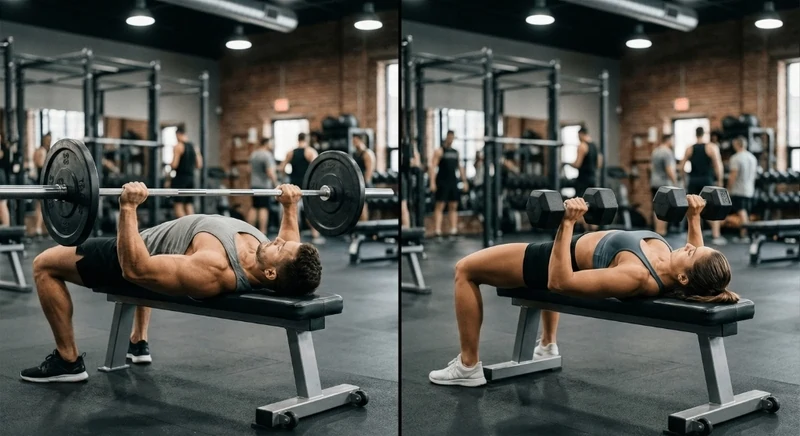
1. The Heavy Hitter: Why You Lift More with a Barbell
If your goal is to move the maximum amount of weight possible, the barbell wins every time. It's not just a feeling; it's a physiological fact.
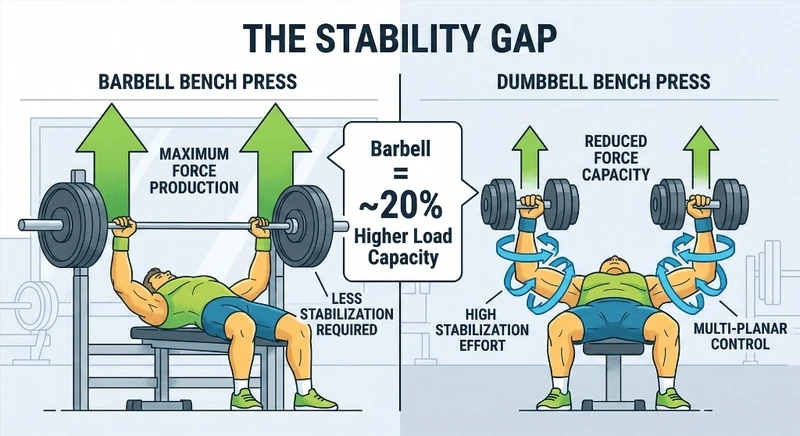
Research consistently shows that individuals can lift significantly more weight using a barbell compared to dumbbells. In a landmark study by Saeterbakken et al. (2011), researchers found that the 1-Repetition Maximum (1RM) for the dumbbell bench press was approximately 17% lower than the total weight lifted with a barbell [1], or the other way around roughly 20% more weight on the barbell.
Why the gap? It comes down to stability.
When you hold a barbell the bar provides inherent stability, allowing your primary movers—the pectorals and triceps—to focus entirely on vertical force production. With dumbbells, each arm must stabilize the weight independently in three-dimensional space. Your nervous system "throttles" the power output of your large muscles to ensure you don't injure yourself [2].
2. Muscle Activation: Which One Actually Grows Your Chest?
Many lifters assume that because you can lift more weight with a barbell, it must be better for chest growth. However, Surface Electromyography (sEMG) data—which measures the electrical activity in muscles—tells a more nuanced story.
The Pectoralis Major (The Chest)
Surprisingly, when comparing the two exercises at similar relative intensities (e.g., both at an 8-rep max), the activation of the pectoralis major is remarkably similar. Saeterbakken et al. (2011) found no significant difference in the activation of the "pecs" between the barbell and dumbbell variations [1].
However, some research suggests an edge for dumbbells in specific phases of the lift. A study by Farias et al. (2017) noted that the dumbbell bench press might elicit significant higher total pec activation [3]. This may be because it allows for a greater horizontal adduction (the "squeezing" motion) at the top of the rep.
The Triceps Brachii
This is where the barbell takes a definitive lead. Because the barbell allows for higher loads and a fixed hand position, the triceps are forced to work much harder to lock out the weight. The sEMG activity in the triceps is significantly higher during the BBBP than the DBBP [1]. If your goal is "thick" arms to go with your chest, the bar is your best friend.
The Biceps Brachii (The Stabilizers)
Wait, biceps during a chest press? Yes. In the DBBP, the biceps act as dynamic stabilizers to prevent the dumbbells from drifting outward. Research shows that biceps activation is substantially higher (up to 75%) during the dumbbell press compared to the barbell press [1]. This reinforces the idea that dumbbells are superior for developing overall shoulder stability and "integrative" strength.
| Muscle | Barbell Bench Press | Dumbbell Bench Press |
|---|---|---|
| Pectoralis Major | High | High (edge in adduction phase) |
| Triceps Brachii | Significantly higher | Moderate |
| Biceps Brachii | Low | Up to 75% higher (stabilization) |
| Anterior Deltoid | High | High |
Select your primary training objective to see the recommended tool.
3. Range of Motion and Joint Health
One of the biggest arguments for the dumbbell bench press is the Range of Motion (ROM).
With a barbell, the movement is physically stopped when the bar hits your chest. This "hard stop" can be problematic for lifters with long limbs or shallow rib cages. Dumbbells, however, allow the hands to descend past the level of the torso, creating a greater stretch on the pectoral fibers.
Furthermore, the barbell forces your wrists and elbows into a fixed, pronated (palms forward) position. For many, this leads to a phenomenon known as "Weightlifting Shoulder" or distal clavicular osteolysis—a common overuse injury in heavy benchers [4].
Dumbbells offer "freedom of movement." You can use a neutral grip (palms facing each other) or a semi-supinated grip, which opens up the subacromial space in the shoulder joint. This significantly reduces the risk of impingement and AC joint stress [5].
4. Practical Application: How to Program
You don't have to choose just one. In fact, the most effective hypertrophy programs utilize both. Here is how to apply the science to your routine:
The Case for the Barbell
- When to use: Perform these first in your workout when your central nervous system is fresh.
- Rep Range: 3–8 reps.
- The Goal: Progressive overload. Focus on adding weight to the bar over time. The high mechanical tension is a primary driver of growth [6].
The Case for Dumbbells
- When to use: Use these as a primary accessory movement or as your main lift if you have shoulder issues.
- Rep Range: 8–15 reps.
- The Goal: Metabolic stress and ROM. Focus on the deep stretch at the bottom and the hard squeeze at the top.
Based on the 17% strength discrepancy found in research [1]. Enter your barbell bench press 1RM to find your dumbbell equivalent.
5. Summary: Which is Better?
The "Barbell vs. Dumbbell" debate isn't about which is better, but which is better for your specific needs right now.
- Choose the Barbell if: You want to maximize your 1RM, you are training for powerlifting, or you want to maximize triceps involvement.
- Choose Dumbbells if: You have a history of shoulder pain, you want to maximize the range of motion for chest hypertrophy, or you are looking to improve your stabilizing strength.
The science is clear: the barbell allows for more weight [1], while dumbbells offer more freedom and higher stabilizer activation [1], [3]. By rotating both into your training cycle, you ensure that you are checking every box—strength, stability, and size.
Conclusion
Building a legendary chest requires more than just showing up; it requires a strategic approach to the tools at your disposal. The barbell is your sledgehammer—use it to break through strength plateaus. The dumbbells are your scalpel—use them to carve out detail, improve symmetry, and keep your shoulders healthy for the long haul.
Next time you head to the bench, don't just grab what's available. Grab the tool that matches your goal for the day. Your gains—and your shoulders—will thank you.
References
- Saeterbakken, A. H., van den Tillaar, R., & Fimland, M. S. (2011). A comparison of muscle activity and 1-RM strength of three chest-press exercises with different stability requirements. Journal of Sports Sciences, 29(5), 533-538.
- Behm, D. G. (1995). Neuromuscular implications and applications of resistance training. Journal of Strength and Conditioning Research.
- Farias, D. A., Willardson, J. M., Paz, G. A., Bezerra, E. S., & Miranda, H. (2017). Maximal Strength Performance and Muscle Activation for the Bench Press and Triceps Extension Exercises Adopting Dumbbell, Barbell, and Machine Modalities Over Multiple Sets. Journal of Strength and Conditioning Research, 31(7), 1879-1887.
- Schwarzkopf, R., Ishak, C., Elman, M., Jaffe, F., & Sherman, O. (2008). Distal clavicular osteolysis: a review of the literature. Bulletin of the NYU Hospital for Joint Diseases, 66(2), 94-101.
- Fees, M., Decker, T., Snyder-Mackler, L., & Axe, M. J. (1998). Upper extremity weight-training modifications for the injured athlete. A clinical perspective. The American Journal of Sports Medicine, 26(5), 732-742.
- Schoenfeld, B. J. (2010). The mechanisms of muscle hypertrophy and their application to resistance training. Journal of Strength and Conditioning Research, 24(10), 2857–2872.